Here is the thing about children and eyesight: a child who has never seen clearly does not know it. Whatever they see is all they have ever seen, so they assume the board is blurry for everyone, that everyone gets headaches after reading, that this is simply what school feels like.
Which means parents and teachers cannot wait for a child to say I cannot see well. That sentence almost never comes. What comes instead are signs, and the five below are the ones we and eye care professionals encounter most. None of them proves a vision problem on its own, and any of them is a good reason to get a check.
1. Squinting, Head Tilting or Covering One Eye
These are the body’s little workarounds. Squinting temporarily sharpens a blurry image, a head tilt can compensate for eyes that do not quite work together, and covering one eye shuts off a doubled or weaker picture. Kids do all of this unconsciously, at the TV, at the dinner table, over homework. If you keep seeing the same adjustment, the eyes are asking for help.
2. Sitting Too Close to Everything
The child who parks a foot from the television, holds the tablet against their nose, or hunches low over the page has often simply moved the world to where it is clear. Nearsightedness typically appears and progresses during the school years, which is why the child who was fine in second grade may genuinely not see the board in fifth. Distance behavior is one of the clearest clues parents can spot at home.
3. Losing Their Place While Reading
Skipped lines, repeated lines, a finger dragged under every word long past the age classmates stopped, slow laborious reading from a child who is clearly bright: these can be signs the eyes are struggling to track smoothly across a page. It gets mislabeled as inattention or a reading problem, and sometimes it is. Sometimes it is vision, and the guidance for parents at the American Optometric Association is blunt about how often tracking and focusing problems hide inside reading struggles.
4. Headaches, Eye Rubbing and Tired Eyes
A child whose eyes are working overtime to focus pays for it physically: headaches after school or reading, frequent eye rubbing when they are not sleepy, watery or tired eyes by evening. Any one instance means nothing, and every child rubs their eyes sometimes. The pattern is what matters, especially when it clusters around close-up work.
5. Avoiding Reading and Close Work Altogether
Children are efficient: they avoid what feels bad. The child who will do anything except sit down with a book, whose attention evaporates specifically during close-up tasks, who says reading is boring with real feeling, may be telling the truth as they experience it, because reading through a vision problem is genuinely exhausting. Vision is not the only explanation for avoiding books. It is the explanation nobody checks.
What to Do If Any of This Sounds Familiar
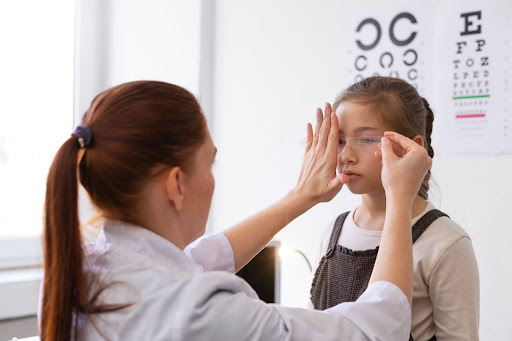
Do not panic, and do not wait either. Book a comprehensive eye exam with an eye doctor, and tell them exactly which signs you have noticed, because those observations guide the exam. Mention it to the school nurse too. Most of what exams find is fixable, and often the fix is as simple as glasses, which is why our own screening process exists: to catch these children early, at school, before the struggling gets labeled as something else.
This is why Vizavance does what it does. A child who can suddenly see the board is a different student within weeks, and no child should fall behind over a problem this findable and this fixable.
Frequently Asked Questions
My child passed the school screening. Can they still have a vision problem?
Yes. Screenings are a strong first filter and catch many problems, but some issues, particularly with focusing and eye teaming, only show up in a comprehensive exam. If the signs above persist after a passed screening, book the full exam and describe what you are seeing.
At what age can a child have an eye exam?
Far earlier than most parents expect, including infancy. Eye doctors have age-appropriate methods that do not depend on reading letters, so no child is too young to be checked. If you have concerns now, the right time for an exam is now.
Could these signs be something other than vision?
They could, and that is worth saying plainly, since attention, learning differences and plain tiredness can produce similar behavior. The point of an eye exam is that it settles the vision question quickly and inexpensively, so whatever support the child needs next is built on facts rather than guesses.
Will my child resist wearing glasses?
Less than you fear. Children who genuinely need glasses usually notice the difference immediately, and the world coming into focus is its own motivation. Letting kids pick their frames helps, and modern children’s frames are tough enough for recess. The battles parents dread mostly do not arrive.
What if we cannot afford an exam or glasses?
Start with what is free: our school screenings cost families nothing, and for eligible Oklahoma families SoonerCare generally covers children’s eye exams and glasses. If a referral or these signs are sitting on your kitchen counter, cost has solutions, so do not let it be the reason the check never happens.