Almost no child announces that they cannot see clearly. They assume everyone sees the way they do, because they have nothing to compare it against.
So vision problems tend to surface as something else entirely. Behaviour, reading difficulty, headaches, or a teacher mentioning that a bright child seems to be struggling. Here is what parents usually notice first.
Why Children Do Not Report It
This is the single most important thing for a parent to understand.
A child with reduced vision in one eye or gradual short sightedness has no reference point. Blurry has always been normal. There is nothing to complain about because nothing has changed from their perspective.
Gradual onset compounds it. Vision that declines slowly gives the child time to adapt, and children adapt remarkably well by moving closer, squinting or simply avoiding tasks that are difficult.
This is also why passing a quick school check does not always settle the question. A basic distance chart can miss focusing problems, eye coordination difficulties and reduced vision in one eye where the other compensates.
Behaviours At Home
Sitting very close to the television, or moving progressively closer over months.
Holding books, tablets or phones unusually close to the face.
Squinting, or tilting the head to one side when looking at something. Head tilting in particular is worth noting, because it can indicate the child is compensating for a coordination problem.
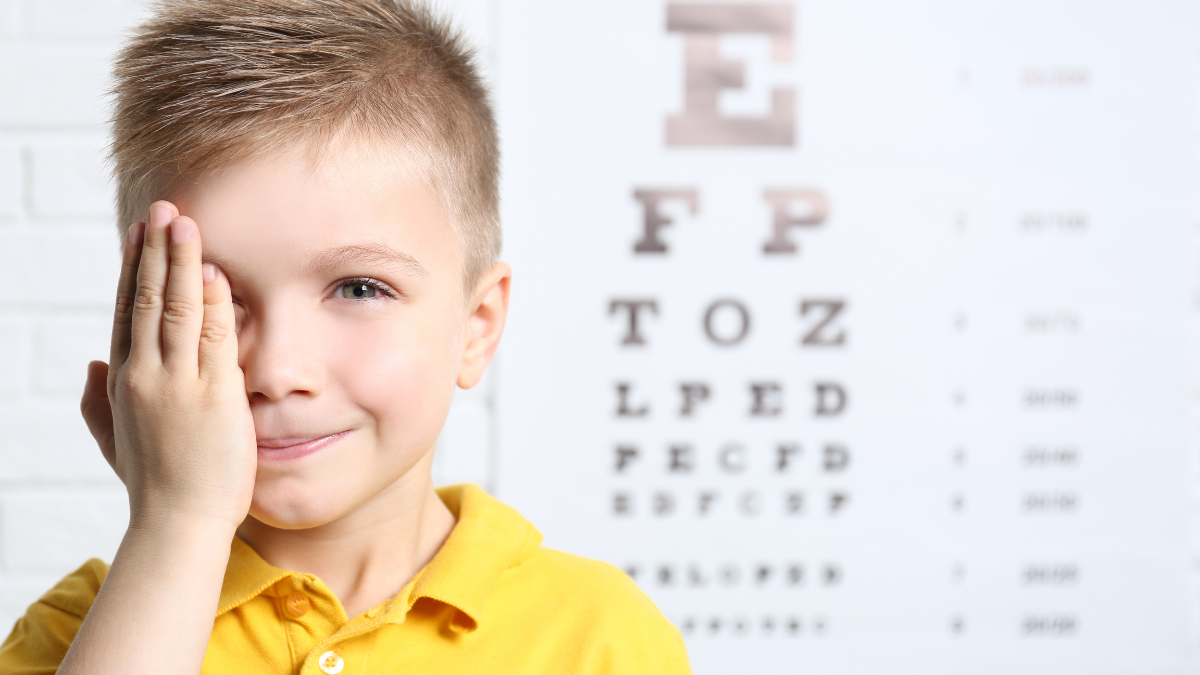
Covering or closing one eye to focus, which is one of the more specific signs and warrants attention.
Frequent eye rubbing, unrelated to tiredness.
Losing place while reading, using a finger to track, or skipping lines repeatedly.
Signs That Show Up At School
Teachers frequently notice before parents do, simply because they see the child alongside thirty others doing the same task.
Difficulty copying from the board, or asking to move seats.
Reading below expected level, or avoiding reading entirely. Children rarely persist with something that is physically uncomfortable.
Short attention span on close work specifically, while concentration on other activities remains fine. That contrast is a useful signal.
Reluctance to participate in ball sports, which require distance judgement and depth perception.
Handwriting that is difficult to keep on the line, or unusual spacing.
Physical Signs Worth Acting On
Headaches, particularly in the afternoon or after school work. Sustained focusing effort is tiring and it produces genuine physical symptoms.
Eye strain, watering eyes or complaints of tired eyes after reading.
One eye that turns inward or outward, even occasionally or only when the child is tired. This should always be evaluated rather than watched, because misalignment can lead to reduced vision in the affected eye.
White or unusual reflection in photographs where one eye does not show the normal red eye effect. This is uncommon and should be checked promptly.
Excessive light sensitivity or unusual clumsiness may also warrant assessment.
What Parents Frequently Mistake It For
This is where vision problems cost children the most, because the wrong explanation leads to the wrong response.
Attention difficulties are the most common misattribution. A child who cannot see the board comfortably looks inattentive, and the behaviour is genuinely inattentive even though the cause is not.
Reading difficulty gets attributed to ability or effort. A child working twice as hard to see the page is not a reluctant reader, though they will become one.
Behaviour problems in class frequently improve when the underlying visual difficulty is corrected.
Clumsiness and avoidance of sport get read as personality rather than as depth perception.
This is why screening matters even where a parent has no specific concern. Programs offering free vision screening for children exist partly because so many problems are attributed to something else first.
When To Get Vision Checked
Guidance generally recommends screening in infancy and early childhood, before school entry, and periodically through the school years.
Beyond the schedule, any of the signs above justifies a check regardless of when the last one was. Vision changes as children grow, particularly through growth spurts.
Family history matters. Where a parent or sibling needed glasses early, or where there is a history of lazy eye or misalignment, earlier and more frequent checks are sensible.
A screening is not the same as a full eye examination. Screening identifies children who need further assessment, and a referral is a normal outcome rather than a cause for alarm.
One practical note for parents. If your child does need glasses, expect some resistance at first and expect it to pass quickly. Children who can suddenly see clearly generally decide the glasses are worth keeping on within a few days, because the difference is immediately obvious to them in a way it never was before.
Frequently Asked Questions
How do I know if my child needs glasses?
Look for sitting very close to screens, holding books close, squinting, head tilting, covering one eye, frequent eye rubbing, losing place while reading, headaches after school work, or difficulty copying from the board. Children rarely report the problem themselves.
Why do children not say when they cannot see clearly?
Because they have no reference point. Blurry vision has always been normal for them, so nothing seems wrong. Gradual onset makes this worse, since the child adapts by moving closer, squinting or avoiding difficult tasks.
Can vision problems be mistaken for attention or learning difficulties?
Frequently. A child who cannot see the board comfortably appears inattentive, and reading difficulty caused by visual strain is often attributed to ability or effort. Behaviour and concentration commonly improve once the visual problem is corrected.
Is a school vision screening enough?
Screening is valuable and it has limits. A basic distance chart can miss focusing problems, eye coordination difficulties and reduced vision in one eye where the other compensates. Any concerning sign warrants a full examination regardless of a passed screening.
At what age should children have their vision checked?
Guidance generally recommends checks in infancy and early childhood, before school entry, and periodically through school years. Earlier and more frequent checks are sensible where there is a family history of glasses in early childhood, lazy eye or eye misalignment.